Showing posts with label Corona Virus. Show all posts

Monday, December 14, 2020

More than ever, get vaxxed and beat Omicron


In this updated look at the Covid-19 vaccine we examine its rollout, one year ago. Now with the Omicron variant ravaging the world, getting the vaccine is more important than ever.  Stubborn resistance continues...and Covid variations will continue to happen unless we get everyone vaxxed.

How did that COVID-19 vaccine happen so fast? 

Years, even decades of research brought us to yesterday, the initial rollout of a vaccine for COVID-19, the most disastrous public health calamity in modern times.

In layman's terms, the Pfizer and Moderna vaccines are all about genetics, DNA, and cell biology. The vaccine utilizes our genetic processes and what they do...which is to create life in our bodies and in all living things. We lay people have known about genetics since high school, when we studied a little bit about Gregor Mendel and his experiments with peas. Mendel discovered the basic principles of heredity and laid the mathematical foundation of the science of genetics. 

What James D. Watson and Francis Crick discovered by 1953, and which revolutionized biology and medicine, was how each of our 30 trillion cells (except for mature red blood cells) is able to pack inside its nucleus the 20,000 genes that serve as the instruction manual for us and for all living things.

DNA, deoxyribonucleic acid, is the material from which the 46 chromosomes in each cell's nucleus are formed. DNA contains the codes for the body's approximately 20,000 genes, which govern all aspects of cell growth and inheritance. Watson and Crick discovered that DNA has a double helix structure--two intertwined strands resembling a spiraling ladder. A gene is a distinct section of that DNA and contains the codes for producing specific proteins involved in our body function. In a very short-handed description, genes send information to single-strand structures called messenger RNA (messenger ribonucleic acid). It is the messenger RNA that leaves the cell's nucleus and begins the process of protein building, the essential work of life.

What the scientists and doctors at Pfizer accomplished was to harness the messenger RNA of the Corona-19 virus, which is the active agent of the of the corona virus. The scientists made a synthetic copy of the virus's messenger RNA instead of using a section of living, or dead, virus as has been typically done in previous vaccines. Also, it has been reported that the Pfizer and the Moderna vaccines are less risky to the body and easier to make in mass doses...qualities much needed in an unprecedented pandemic.

As noted scientist and Nobel laureate Leon Cooper said, our investment in basic scientific research must be generous and ongoing. Advances that led to the creation of the personal computer, for example, relied on previous research on transistors, which relied on previous research in basic physics. Had the revolution in our understanding of genes and cellular biology not stood where it is, these vaccines, providing hope to a despairing world, would not have been possible.

Contents 

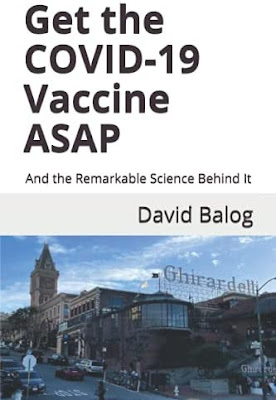
FOREWORD: HOW A TINY VIRUS CHANGED THE WORLD…..1. LET'S GET BACK TO NORMAL, WHEREVER POSSIBLE….2. THIS IS NOT THE SEASONAL FLU-- IT'S MUCH MORE DANGEROUS….. 3. OUR LUNGS AND COVID-19: A CLOSER LOOK…..4. HOW DID THE COVID-19 VACCINES GET DEVELOPED SO FAST?.....5. THE VACCINES ARE SAFE: THE ROLE OF CLINICAL TRIALS…..6. IMMUNITY: A SMART SYSTEM AND ITS SECRETS…..7. A POWERFUL ACHIEVEMENT: DR. JONAS SALK CONQUERS POLIO…. 8. TAKE PART IN HISTORY...BE THE CHANGE YOU WANT TO SEE HAPPEN….. 9. SCIENCE SAVES MONEY, SAVES LIVES…..10. THE AGE OF THE GENOME BODES WELL FOR HUMAN HEALTH…..11. FAQS ABOUT THE COVID-19 VACCINES EPILOGUE: LIVING UNDER THE UNIQUE STRESS OF A PANDEMIC 


Online review:

"You might have read articles here and there about the Covid vaccines and the miracle of their development in less than a year. But here in book form, all the ingredients of this remarkable story are brought together in one place by author Dave Balog. Mr. Balog has a medical background, but he writes in clear, easy-to-understand prose that any reader will appreciate.

"Specifically, fundamental questions about the virus and the vaccines are answered in the book such as how did the vaccines get developed in record time, how was safety ensured -- particularly given the speed involved -- and the implications not only for the management of future pandemics, but also for overall public health in general.

"Mr. Balog's book is titled, "Get The Covid-19 Vaccine ASAP." Many people, but by no means everyone, know this. The nine chapters, however, explain why vaccination is so urgent in the face of a still evolving disease, the dimensions of which are detailed therein in no uncertain terms."


About the author 

David Balog, a freelance science/medical writer, served as an editor at the Charles A. Dana Foundation from 1995-2006. There he worked for William Safire, language columnist for the New York Times. David created, wrote, and edited the Dana Sourcebook of Brain Science through four editions. More than 50,000 copies were distributed to elementary schools, middle schools, colleges and to professionals and the general public. He worked with leading brain scientists and doctors, including Nobel laureates. David was also a contributing editor of the Dana Sourcebook of Immunology. and has created the Healing the Brain series of books and videos. Please visit www.HealingTheBrainBooks.Com to learn more. David is a graduate of Hamilton College, where he received a BA in History.





Thursday, March 5, 2020

Diabetes and Coronavirus, CO-VID19


Take charge of your health.


Logo

  • COVID-19 & diabetes


COVID-19 is a new and potentially serious coronavirus. There are many coronaviruses, ranging from the common cold to much more serious viruses such as Severe Acute Respiratory Syndrome (SARS) and Middle East Respiratory Syndrome (MERS). They are viruses that have been transmitted from animals to people. In severe cases, coronaviruses can cause infection in the lungs (pneumonia), kidney failure and even death.
The World Health Organization (WHO) has declared the COVID-19 outbreak to be a public health emergency of international concern. At present there is no vaccine against COVID-19.
Common signs are typical flu-like symptoms: a fever, cough, breathing difficulties, tiredness and muscle aches. Symptoms usually start within 3-7 days of exposure to the virus, but in some cases it has taken up to 14 days for symptoms to appear.
People of all ages can be infected. For many (more than 80% of cases), COVID-19 is mild, with minimal flu-like symptoms. Some have not shown symptoms or only very mild symptoms, more like a common cold. The majority of people who have caught the virus did not need to be hospitalised for supportive care. However, in approaching 15% of cases COVID-19 has been severe and in around 5% of cases it has led to critical illness. The vast majority (around 98%) of people infected to date have survived.

When people with diabetes develop a viral infection, it can be harder to treat due to fluctuations in blood glucose levels and, possibly, the presence of diabetes complications.

Older people and people with pre-existing medical conditions (such as diabetes, heart disease and asthma) appear to be more vulnerable to becoming severely ill with the COVID-19 virus. When people with diabetes develop a viral infection, it can be harder to treat due to fluctuations in blood glucose levels and, possibly, the presence of diabetes complications. There appear to be two reasons for this. Firstly, the immune system is compromised, making it harder to fight the virus and likely leading to a longer recovery period. Secondly, the virus may thrive in an environment of elevated blood glucose.
Like any other respiratory disease, COVID-19 is spread through air-droplets that are dispersed when an infected person talks, sneezes or coughs. The virus can survive from a few hours up to a few days depending on the environmental conditions. It can be spread through close contact with an infected person or by contact with air droplets in the environment (on a surface for example) and then touching the mouth or nose (hence the common advice circulating on hand hygiene and social distancing).
What can people with diabetes and their loved ones do?
For people living with diabetes it is important to take precautions to avoid the virus if possible. The recommendations that are being widely issued to the general public are doubly important for people living with diabetes and anyone in close contact with people living with diabetes.
  • Wash hands thoroughly and regularly.
  • Try to avoid touching your face before you have washed and dried your hands.
  • Clean and disinfect any objects and surfaces that are touched frequently.
  • Don’t share food, glasses, towels, tools etc.
  • When you cough or sneeze, cover your mouth and nose with a tissue or use the crook of your arm if you don’t have a tissue to hand (dispose of the tissue appropriately after use).
  • Try to avoid contact with anyone showing symptoms of respiratory illness such as coughing.
  • Think whether you can make changes that will help protect yourself or loved ones. For example, can you avoid unnecessary business travel? Can you avoid large gatherings? Can you avoid public transport?
  • If you are ill with flu-like symptoms, stay at home.
If you have diabetes:
  • Prepare in case you get ill.
  • Make sure you have all relevant contact details to hand in case you need them.
  • Pay extra attention to your glucose control.
  • If you do show flu-like symptoms (raised temperature, cough, difficulty breathing), it is important to consult a healthcare professional. If you are coughing up phlegm, this may indicate an infection so you should seek medical support and treatment immediately.
  • Any infection is going to raise your glucose levels and increase your need for fluids, so make sure you can access a sufficient supply of water.
  • Make sure you have a good supply of the diabetes medications you need. Think what you would need if you had to quarantine yourself for a few weeks.
  • Make sure you have access to enough food.
  • Make sure you will be able to correct the situation if your blood glucose drops suddenly.
  • If you live alone, make sure someone you can rely on knows you have diabetes as you may require assistance if you get ill.
COVID-19 is a new coronavirus. The situation is not fully clear at this point, so keep informed of the latest developments. Look out for updates and advice from your government, national diabetes association and other reliable sources

Take charge of your health

Tuesday, March 3, 2020

Seven Important Corona Virus Tips


Learn about the brain and health.

Dr. James Robb is a Pathologist and has extensively studied Coronavirus for years. Below is something he put together for his colleagues in medicine and science. I think it’s excellent.

I think masks are really not helpful other than keeping you from touching your face. Otherwise good stuff.

Subject: What I am doing for the upcoming COVID-19 (coronavirus) pandemic

Dear Colleagues, as some of you may recall, when I was a professor of pathology at the University of California San Diego, I was one of the first molecular virologists in the world to work on coronaviruses (the 1970s). I was the first to demonstrate the number of genes the virus contained. Since then, I have kept up with the coronavirus field and its multiple clinical transfers into the human population (e.g., SARS, MERS), from different animal sources. The current projections for its expansion in the US are only probable, due to continued insufficient worldwide data, but it is most likely to be widespread in the US by mid to late March and April.

Here is what I have done and the precautions that I take and will take. These are the same precautions I currently use during our influenza seasons, except for the mask and gloves.:

1) NO HANDSHAKING! Use a fist bump, slight bow, elbow bump, etc.
2) Use ONLY your knuckle to touch light switches. elevator buttons, etc.. Lift the gasoline dispenser with a paper towel or use a disposable glove.
3) Open doors with your closed fist or hip - do not grasp the handle with your hand, unless there is no other way to open the door. Especially important on bathroom and post office/commercial doors.
4) Use disinfectant wipes at the stores when they are available, including wiping the handle and child seat in grocery carts.
5) Wash your hands with soap for 10-20 seconds and/or use a greater than 60% alcohol-based hand sanitizer whenever you return home from ANY activity that involves locations where other people have been.
6) Keep a bottle of sanitizer available at each of your home's entrances. AND in your car for use after getting gas or touching other contaminated objects when you can't immediately wash your hands.
7) If possible, cough or sneeze into a disposable tissue and discard. Use your elbow only if you have to. The clothing on your elbow will contain infectious virus that can be passed on for up to a week or more!

What I have stocked in preparation for the pandemic spread to the US:

1) Latex or nitrile latex disposable gloves for use when going shopping, using the gasoline pump, and all other outside activity when you come in contact with contaminated areas.

Note: This virus is spread in large droplets by coughing and sneezing. This means that the air will not infect you! BUT all the surfaces where these droplets land are infectious for about a week on average - everything that is associated with infected people will be contaminated and potentially infectious. The virus is on surfaces and you will not be infected unless your unprotected face is directly coughed or sneezed upon.  This virus only has cell receptors for lung cells (it only infects your lungs) The only way for the virus to infect you is through your nose or mouth via your hands or an infected cough or sneeze onto or into your nose or mouth.

2) Stock up now with disposable surgical masks and use them to prevent you from touching your nose and/or mouth (We touch our nose/mouth 90X/day without knowing it!). This is the only way this virus can infect you - it is lung-specific. The mask will not prevent the virus in a direct sneeze from getting into your nose or mouth - it is only to keep you from touching your nose or mouth.

3) Stock up now with hand sanitizers and latex/nitrile gloves (get the appropriate sizes for your family). The hand sanitizers must be alcohol-based and greater than 60% alcohol to be effective.

4) Stock up now with zinc lozenges. These lozenges have been proven to be effective in blocking coronavirus (and most other viruses) from multiplying in your throat and nasopharynx. Use as directed several times each day when you begin to feel ANY "cold-like" symptoms beginning. It is best to lie down and let the lozenge dissolve in the back of your throat and nasopharynx. Cold-Eeze lozenges is one brand available, but there are other brands available.

I, as many others do, hope that this pandemic will be reasonably contained, BUT I personally do not think it will be. Humans have never seen this snake-associated virus before and have no internal defense against it. Tremendous worldwide efforts are being made to understand the molecular and clinical virology of this virus. Unbelievable molecular knowledge about the genomics, structure, and virulence of this virus has already been achieved. BUT, there will be NO drugs or vaccines available this year to protect us or limit the infection within us. Only symptomatic support is available. I hope these personal thoughts will be helpful during this potentially catastrophic pandemic. You are welcome to share this email.

Good luck to all of us!

James Robb, MD FCAP

Learn about the brain and health.