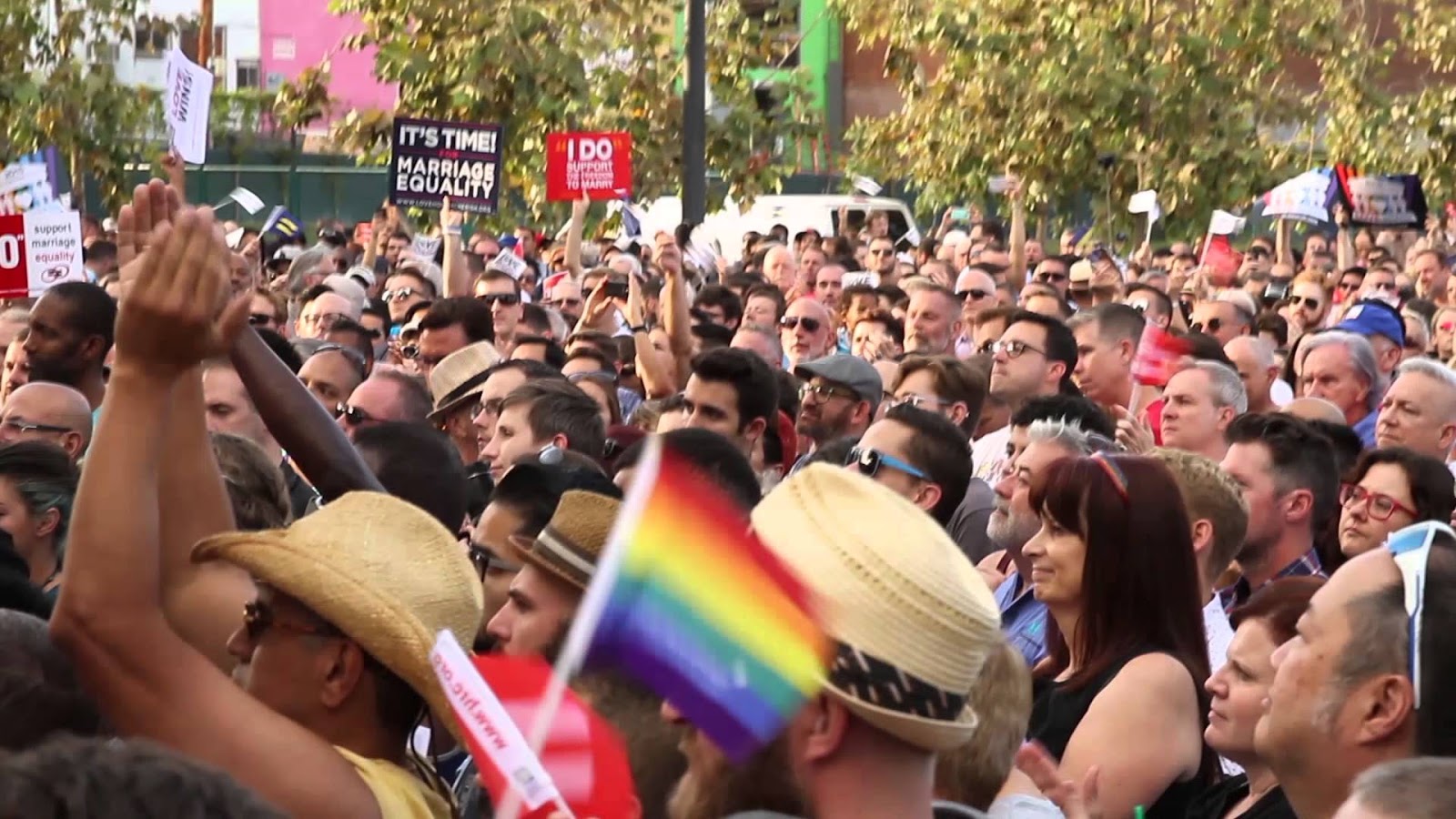
Showing posts with label LGBT families. Show all posts

Sunday, November 27, 2016

Gay youth, health, and Trump


President Lyndon Johnson set up the Kerner Commission in the late 1960s to investigate the underlying causes of nationwide riots (Newark, Washington, DC, Los Angeles, Detroit, etc.). The commission's stunning conclusion was that America was two societies, separate and unequal, increasingly moving apart. As I began to talk to varied audiences with A Thousand Moms, I realized that a similar gap existed today with the gay community. Despite important successes, e.g., marriage equality, mainstream America didn't know about the LGBT community and rather than learning from an increased public awareness of LGBT issues, they remained profoundly unaware of gay life and the severe and unique stresses that can attend it--except in extraordinary circumstances. 

A Thousand Moms' mission is to educate parents, teachers, social workers, counselors, clergy, and the concerned layperson so that in an optimum world, they can support LGBT youth with a deeper understanding of a group of people seemingly from a completely different world. I wrote Healing the Brain: Stress, Trauma and LGBT/Q Youth because I had the training to do it--15 years as an editor to the world's top neuroscientists at the Dana Foundation--and access to my partner Fred's experience in child development. I was also peeved that my previous employer, in its massive reference on the brain, mentioned gay people only once. The reference blithely said that people attracted to the same sex seem to commit suicide in larger numbers and we don't know why. (Or care.) 

So this book is about the brain, but really about surviving extraordinary stress and trauma and protecting our heath. I have been given many accolades for the book, the best one calling it pioneering. But kind words have not translated into wide interest and in this world of self-publishing, the task of getting the word out has been very difficult. Therefore I am now circulating sample chapters so people can get a feel for the book and make an informed decision about getting a copy. Many books on LGBT life get called reference books or "a contribution to the literature," which means being put on a book shelf to die quietly. I am determined not to let that soft bigotry stop this important information from reaching people who can help LGBT youth--and adults--and make a real difference in our lives. We have a public health crisis in the gay community, still and perhaps worsening. And come a new administration that promises rollbacks, not progress, we are going to need education, awareness, and support more than ever. Please take a look at this sample e-book and share it. 

CLICK HERE!


Wednesday, November 23, 2016

Trump's low road to the White House

The human brain has developed over millenia. Like a non-stop power plant, the brain added new structures to basic ones (controlling basic functions like breathing). The crowning achievement is the cortex, the largest brain structure, where higher thought and reasoning take place.

Scientists have learned that sensory input, e.g., sounds, do not have to travel to the cortex to induce fear. Impulses need only travel to a primitive brain structure called the amygdala. 

When FDR delivered his first inaugural address, he appealed to reasoning, though his topic was the fear of a nation shattered by the Great Depression. Like dictators and demagogues through history, Donald Trump goes straight for the lower brain with pointed, uncomplicated messages that require little thought. For example, his nicknamesl for nearly all of his opponents (Low Energy Jeb, Little Marco, Crooked Hillary) make for instant recognition and easy identification--and great ratings for cash-starved cable media. Wash, rinse, repeat.

Trump echoes right wing talk radio hosts, who offer short, immediate solutions that fit neatly into a brief format. No exhausting engagement of the thinking brain required. Fear is our most powerful emotion and when Donald Trump boasted he knew how to win this election, like ad men from Madison Avenue, he knew what worked: the low road to the White House. Hillary Clinton and the Democrats had a long, arduous path to the thinking brain to overcome the power of fear and other powerful emotions.

Monday, November 21, 2016

Heterosexism and the holidays

Thanksgiving marks the start of the trifecta of holidays that spike anxiety in LGBT youth and adults of all ages. In this excerpt from Healing the Brain, we look at the invisible but all-too-real phenomenon of heterosexism, the feeling of gay people that they must give deference to a straight-majority culture.

Despite, or in some cases because of social progress in marriage equality and other matters, pervasiveness of alienation in the lives of the current generation of gay youth is well established. Nevertheless, little is definitively known about the strategies these youth use to cope with stigma and discrimination based on their sexual minority status. Lesbian, gay, bisexual and transgender youth face an array of daunting challenges in addition to many of the developmental stressors facing straight teens.

One of the most difficult stressors gay youth face is heterosexism. This term describes the acculturated and pervasive (intentional or non-intentional) concept that denies, denigrates, and stigmatizes any non-heterosexual form of behavior, identity, relationship, or community. The experience of being stigmatized is at the root of a range of health problems faced by sexual minority adolescents including increased depression, suicide risk, and other mental health disorders. Few researchers have examined the emotional consequences of day-to-day encounters with heterosexism, but many have noted the challenge of maintaining a positive sense of self in the face of chronic negative feedback based in heterosexist attitudes. Recent research has revealed elevated levels of social anxiety in sexual minority adolescents, as well as associations between social anxiety and increased risky sexual behavior.

Forms of heterosexist experiences vary widely, ranging from casual anti-gay remarks to severe physical violence or total social exclusion. Youth encounter heterosexism in diverse settings, including home, school, church, parks, and on the street. Sources of heterosexism were equally wide-ranging, including family members, schoolmates, friends, and religious leaders.

Few researchers have examined the emotional consequences of day-to-day encounters with heterosexism.

Heteroterosexist attitudes by family appeared to be especially stressful for gay youth, in part due to these youths’ emotional and financial dependence on their families. The holiday season, the period between Thanksgiving and New Year’s Day, accounts for many family disruptions over the issue of a child’s sexulity. Youth see this period and the typical gatherings of their nuclear family as an opportunity to begin talking about their true selves. Not coincidentally, this time of year is when the highest incidents of family disruptions occur. Large cities such as San Francisco and New York see an influx of gay youth fleeing their homes and ultimately seeking social services. Relatedly, when television covers an LGBT matter, be it marriage equality or the trauma of the Orlando, FL mass killing at a gay bar, conflicts ensue in families. In 2011, when New York State passed marriage equality, the Ali Forney Center of New York reported a 40 per cent increase in drop-in rates at its youth shelter in New York.


Saturday, November 19, 2016

Radio Free Europe...oops, America

Growing up, many of us heard of Radio Free Europe, an attempt to reach those behind the "Iron Curtain." Here's some information about Radio Free Europe, still operating, and our podcast, designed to be a Radio Free America. Listen to our latest show, LGBT 911.

From Wikipedia:  Radio Free Europe/Radio Liberty (RFE/RL) is a United States government-funded broadcasting organization that provides news, information, and analysis to countries in Eastern Europe, Central Asia and the Middle East "where the free flow of information is either banned by government authorities or not fully developed".[3] RFE/RL is a 501(c)(3) corporation that receives U.S. government funding and is supervised by the Broadcasting Board of Governors, an agency overseeing all U.S. federal government international broadcasting services.[4]
During the Cold War, Radio Free Europe (RFE) was broadcast to Soviet satellite countries and Radio Liberty (RL) targeted the Soviet Union. RFE was founded as an anti-communist propaganda source in 1949 by the National Committee for a Free Europe. RL was founded two years later and the two organizations merged in 1976. Communist governments frequently sent agents to infiltrate RFE's headquarters. Radio transmissions into the Soviet Union were regularly jammed by the KGB. RFE/RL received funds from the Central Intelligence Agency (CIA) until 1972.[5] During RFE's earliest years of existence, the CIA and U.S. Department of State issued broad policy directives, and a system evolved where broadcast policy was determined through negotiation between them and RFE staff.[6]
  
Listen to our latest show, LGBT 911.
 

Wednesday, November 16, 2016

LGBT community and holidays: Stress on steroids, post-Trump

The holiday season brings stresses for everyone and for gay youth, in particular. This year in particular, gay youth and adults face a daunting task at the family dinner table. Here is an excerpt from our new book, Healing the Brain.


Few researchers have examined the emotional consequences of day-to-day encounters with heterosexism.

Heteroterosexist attitudes by family appeared to be especially stressful for gay youth, in part due to these youths’ emotional and financial dependence on their families. The holiday season, the period between Thanksgiving and New Year’s Day, accounts for many family disruptions over the issue of a child’s sexulity. Youth see this period and the typical gatherings of their nuclear family as an opportunity to begin talking about their true selves. Not coincidentally, this time of year is when the highest incidents of family disruptions occur. Large cities such as San Francisco and New York see an influx of gay youth fleeing their homes and ultimately seeking social services. Relatedly, when television covers an LGBT matter, be it marriage equality or the trauma of the Orlando, FL mass killing at a gay bar, conflicts ensue in families. In 2011, when New York State passed marriage equality, the Ali Forney Center of New York reported a 40 per cent increase in drop-in rates at its youth shelter in New York.

Coping Strategies for Gay Youth
Obtaining information and support through the Internet
For many youth, the Internet served as a means of locating gay-affirmative support that might otherwise have been difficult to obtain. One individual posted poetry about his experiences on a website and received feedback that helped him to increase his sense of self-esteem and reduce feelings of isolation. For this youth, the process of writing poetry had other benefits as well, including cognitively reframing his predicament and venting.

Setting boundaries

A common example of such a strategy involved avoiding individuals who expressed heterosexist attitudes. Youth might stop talking to such a person, or take other active measures to avoid having to encounter them, even if they had formerly been friends.

Some youth express the importance of avoiding heterosexist people, though such strategies could leave them vulnerable to additional psychological, physical and material challenges. For example, leaving home without obtaining alternative sources of support appeared to be a particularly risky means of coping.

Adam left his small-town home for Los Angeles due to pervasive heterosexism and anti-gay violence he encountered there. He left with only enough money for train fare and a few essential items, a situation that might have been precarious had he not been able to rely on an aunt living in Los Angeles. He moved in with her and greatly appreciated her support, saying “At least I have one family member that was behind me. But that was the only one.” Another youth, who left home for similar reasons had no money whatsoever, but was able to earn income as a dancer in bars. A third respondent, whose brother regularly beat him and called him a “fag,” coped by living at friends’ homes most of the time.

Passing by telling half-truths

When youth could not avoid the topics that might lead to exposure of their sexual orientation, they often hid their sexual orientation by a careful use of half-truths. For these youth, passing often involved steering a middle course between overt lying and social or familial rejection.

Passing by keeping a low profile in heterosexist environments

Gay people often encounter heterosexist messages in religious settings. Rather than avoid such settings entirely, many respondents continue to attend church, while remaining closeted in that particular environment. In this way, respondents felt they were able to derive benefits from such experiences in spite of hearing heterosexist messages. This was explained by one respondent, who said that he continued to attend church in spite of his discomfort because he valued his relationship with God. Another respondent utilized passing to minimize the embarrassment he and a gay friend would otherwise experience in church when straight men stared at their stereotypically gay attire.

Covering sexual orientation

Some youth who had fully disclosed their sexual orientation nevertheless adopted strategies to minimize its obviousness. Respondents whose families discouraged them from disclosing their sexual orientation to others sometimes used covering as a compromise between their families’ wishes and their own. The following respondent recounts an argument in which his parents insisted that he keep his sexual orientation a secret at school.


Listening selectively in stigmatizing environments

Youth often use attentional deployment strategies in religious settings, sometimes by simply ignoring anti-gay messages when they were expressed in church. In order to ignore such heterosexist messages, youth first had to listen to and critically evaluate the ideas they were hearing.

Ignoring provocations

LGBT youth who encounter prejudicial statements directed at them often opted to ignore them. The following respondent reported that when he was younger his mother and sister often said things to him that made him “not feel good about myself”. He described that he “used to go so crazy, I yelled at them... like knocked over the TV and stereo, knocked over the whole house.” As he got older, he learned to ignore provocations and this helped him to avoid yelling and acting out violently at home. He also stated that he usually uses a similar strategy when encountering prejudice in public settings.

 Get the book!


Thursday, November 10, 2016

Minority stress, now on steroids


Fifty per-cent of America is angry at the election results. None more than minorities. Here is the section on minority stress from our book, Healing the Brain.

The following is adapted from “Public Health Implications of Same-Sex Marriage,” Am J Public Health. 2011 June; 101(6): 986–990. William C. Buffie, MD. (Dr. Buffie has provided medical information for A Thousand Moms.)

One only has to consider the rash of recent teen suicides resulting from anti-gay bullying to begin to comprehend the magnitude of the public health problem faced by this country and its LGBT sexual minority. Despite the prevalence of same-sex households and campaigns to protect human rights, gay persons find the very nature of their being constantly debated within our legislative bodies, the courts, and the mainstream media. They are subject to ridicule and are commonly the targets of demeaning and derogatory slang terms or insensitive jokes. Their morality and value as human beings are frequently questioned by individuals and organizations ignorant or unaccepting of current medical and social  science literature concerning the gay population….

Being cast in such a light strongly contributes to the phenomenon known as “minority stress,” which members of this community experience in their struggle for validation and acceptance in our heterosexist society.

for LGBT People in America
Wikimedia Commons
To assert and celebrate their community, each year LGBT/Q individuals gather in June at Pride events worldwide.

Unique to the LGBT form of minority stress—as opposed to minority stress engendered by societal prejudice based upon race, ethnicity, gender, or disability—is that one's sexual orientation usually is invisible to others. As a result, in addition to being the target of overt discrimination, LGBT individuals are constantly subject to subtle, inadvertent, or insensitive attacks on the core of their very nature, even by people who profess no disdain or disrespect for them.

For instance, if someone has a lesbian colleague but doesn't know the colleague's orientation, an innocent question—such as asking her if she has a boyfriend, rather than asking “Are you seeing someone special?”—implies a judgment regarding what is “normal.” When the “other” is invisible, faceless, or nameless, it is common for those in power to ignore the reality of the other's existence and the challenges the other faces. This interplay of power and prejudice, whether overt or covert, constitutes the phenomenon of heterosexism. Similarities to the racism and sexism so prevalent during the civil rights movements of past generations are obvious.

Internalizing Prejudice

This sexual-minority status, as explained by Riggle and Rostosky, is defined by a culture of devaluation, including overt and subtle prejudice and discrimination, [one that] creates and reinforces the chronic, everyday stress that interferes with optimal human development and well-being.

LGBT individuals, stigmatized by negative societal attitudes directed at the essence of their being, struggle on a daily basis to balance the dual dangers of publicly engaging their need for equality and validation and remaining closeted to find some calm through an escape from public scrutiny. Many gay persons internalize such discrimination and prejudice. Fractured social-support mechanisms and minority-stress–associated low self-esteem contribute to a high prevalence of self-destructive behaviors, such as substance abuse, suicide, and risky sexual behavior.

Institutionalized stigma stands at the begets higher rates of sexually transmitted diseases, depression, suicide, and drug use.

Hatzenbuehler et al. studied more than 34,000 lesbian, gay, and bisexual participants and found empirical evidence of the negative health effects of discriminatory policies relative to marriage equality. They surveyed participants in 2001 and 2002 on a range of psychological health indicators, and they administered the same survey in 2004 and 2005, after 14 states approved constitutional amendments limiting marriage to opposite-sex unions. In the second set of responses, participants reported significantly higher rates of psychiatric disorders, with increases of 36% for any mood disorder, 248% for generalized anxiety disorder, 42% for alcohol use disorder, and 36% for psychiatric comorbidity. In the comparable control group from states without such amendments during the same time period, there were no significant increases in these psychiatric disorders.

Although causality may be difficult to establish, the association and prevalence of these disorders suggest that institutionalized stigma and its attendant internalized prejudice (i.e., minority stress) stand at the forefront of this cycle, begetting higher rates of sexually transmitted diseases, depression, suicide, and drug use—all of which, when combined with suboptimal access to health care and fractured family-support systems, eventually contribute to higher overall mortality as well as morbidity from various cancers, cirrhosis, hypertension, and heart disease….


Wednesday, October 5, 2016

VP debate an insult to LGBT community

From the Advocate:

It’s still sinking in: Mike Pence’s discrimination against LGBT people as governor of Indiana wasn’t deemed important enough to discuss during the vice-presidential debate Tuesday.
How can that be? 
Pence is still the governor of Indiana. He signed the so-called Religious Freedom Restoration Act just last year. It was among the most famous of these laws, but similar ones have been proposed across the country. The effect of such legislation is that businesses can legally refuse service to LGBT people merely by citing their religious beliefs.
The Pence version of the RFRA was partly repealed in Indiana, but an even more draconian version of the law passed in Mississippi; it's now been blocked by a federal court. No one could blame the LGBT people of Mississippi if they’re feeling a little invisible today. 
Honestly, I feel a little insulted that as my community faces a wave of discrimination, we were ignored.
Sometimes it feels like the world read about the Supreme Court’s ruling on marriage equality and just checked a box; the gays are fine now. 
Has the media already forgotten that, just a few months ago, a man went into the Pulse nightclub and killed 49 people in an incredibly bloody act of hate against LGBT people? I haven’t forgotten. Orlando Pride is later this week. Trust me that no one there has forgotten.  
Mike Pence helps create an atmosphere in which we are targets, in which we are not safe. RFRAs like his send the message to crazies that LGBT people are less human. Pence ought to be confronted — or at least asked — about whether his policies and rhetoric bear any responsibility for breeding a culture of homophobia and transphobia.
Debate moderator Elaine Quijano, a respected CBS news correspondent, deserves credit for asking about implicit bias among our police force against African-Americans, for confronting Pence about how exactly his boss plans to deport millions of people. But to not ask Pence about his level of responsibility for a culture of hate against LGBT people is itself irresponsible. To instead ask Pence about how his faith plays a role in his governing only adds to the insult.